The Legacy of Grandmaster Charles Graham
This section is dedicated to my instructor, mentor, and dear friend, Grandmaster Charles “Chuck” Graham.
In July 2026, Grandmaster Graham retired from active participation in the martial arts. Although his time as an instructor has come to a close, his influence will continue through the generations of students he trained, mentored, and inspired. It is now our responsibility to preserve what he built, pass along what he taught, and do our part to keep his legacy alive.
To those of us who trained under him, Grandmaster Graham was much more than a martial-arts instructor. He was a father figure and friend. As many of us discovered, his school was much more than a place to train—it was a family. The lessons he taught extended far beyond techniques, forms, and rank. He taught discipline, loyalty, perseverance, responsibility, and the importance of standing beside one another. His influence helped shape not only the martial artists we became, but also the men and women we grew to be.
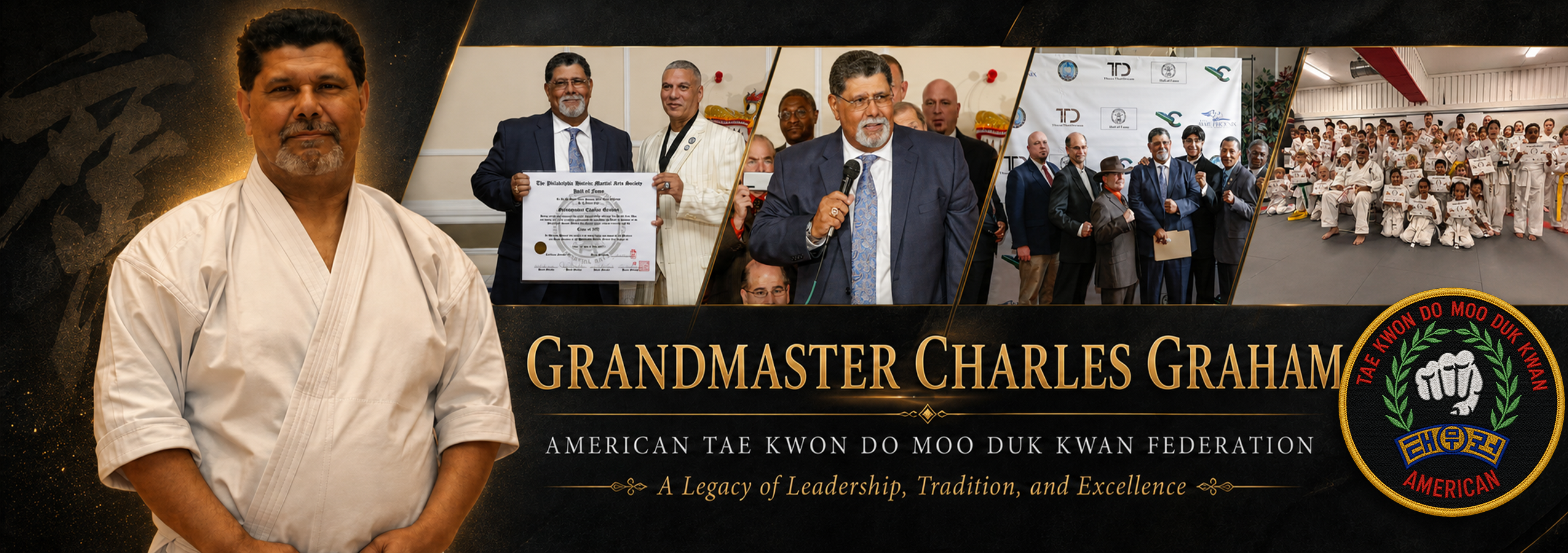
Charles Graham began his martial arts training in 1966 at Fort Dix, New Jersey, when he was fifteen years of age. He received his Black Belt on January 10, 1971 under Grandmaster Forrest Blair and Grandmaster Eugene Perceval Jr., founder of Tae Kwon Do Moo Duk Kwan USA. Grandmaster Graham holds the rank of 10th Dan Black Belt in American Tae Kwon Do Moo Duk Kwan, 8th Dan Black Belt in Tae Kwon Do Moo Duk Kwan USA and Black Belt in the Norway Kung Fu Association.
After graduating high school, Grandmaster Graham enlisted in the U.S. Marine Corps where he spent the next four years serving his country. While in the USMC, he started his long journey to refine and enhance his martial arts skills, knowledge and teaching by training and studying with practitioners in various styles and systems of martial arts which included: Shotokan, Goju Ryu, Judo, Aikido, Kung Fu/Wu Shu, Modern Arnis de Mano, Tae Kwon Do (ITF, WTF & American), Tang Soo Do and Hapkido.
Over the years, Grandmaster Graham developed a distinctive instructional methodology that blended the strongest attributes of various martial arts with his traditional values and a distinctly American approach. This unique combination became the foundation of the American Tae Kwon Do Moo Duk Kwan system.
In 1977, Charles Graham severed ties with Grandmaster Forrest Blair and Eugene Perceval Jr. and founded the American Tae Kwon Do Moo Duk Kwan Federation. Over the past 50 years, Grandmaster Graham’s organization has grown to over 10 schools in both the United States and Norway. Grandmaster Graham has produced a host of Grandmasters, Masters and over 150 Black Belts.
Grandmaster Graham is known for giving back to the community. This has been a hallmark of his character and commitment to the youth and adults. Due to his achievements in the martial arts, he was inducted into the American Asian Hall of Fame (2003) and Philadelphia Historical Martial Arts Society Hall of Fame.
The Basement Days – by Ray Thomann
In 1977, I was attending Oakview School, an elementary school in Pemberton Township, New Jersey. At the time, I had been training under Jeffrey Lewis, but when he relocated to Virginia, my martial arts journey suddenly came to a halt. I had already developed a deep love for the arts, and losing my instructor was devastating.
Then, one afternoon after dismissal, I was walking down the hallway toward my bus when I heard a familiar sound coming from the gym—the powerful kiai of students training. I asked my teacher for permission to look inside, and there I saw Grandmaster Charles Graham teaching a martial arts class.
I could hardly contain my excitement. I immediately told my father what I had discovered, and he gathered the information about the program and enrolled me in the classes.
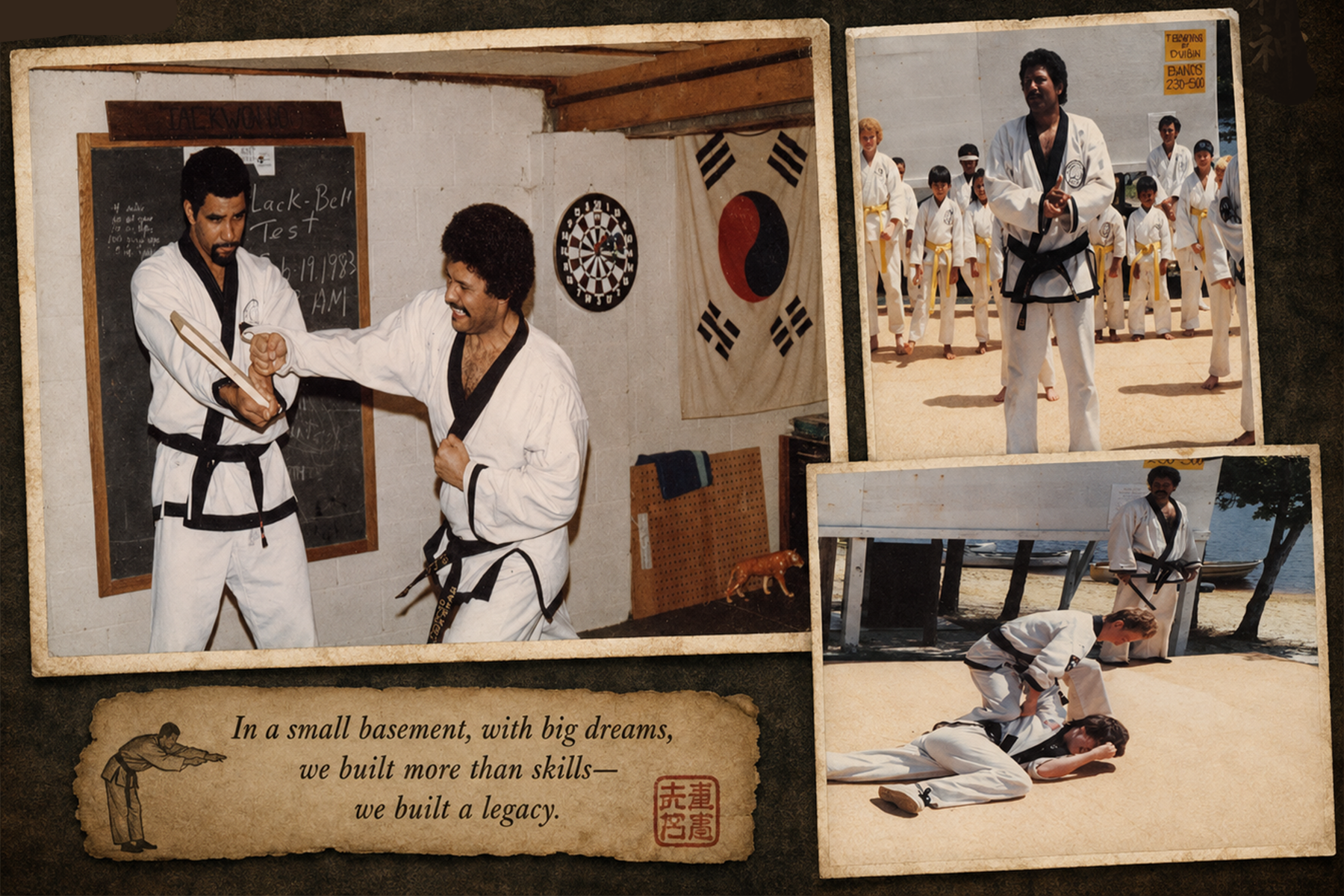
After I attended several sessions at the school, Grandmaster Graham invited me to continue my training at his home on Phillips Avenue. That invitation marked the beginning of what we would fondly come to remember as the “good old basement days”—and the beginning of a relationship that would shape my life in ways I could never have imagined.
The basement days hold some of my fondest memories of the martial arts. Those humble surroundings became the birthplace of what would eventually grow into the American Moo Duk Kwan Federation.The basement days represented more than the early stages of an organization. They were a time when its culture, standards, and leadership were being formed. Future instructors were being trained and mentored, and it was not uncommon for several experienced black belts and masters to attend the same class.
Among those who contributed to this formative period were Johnnie Q. Wade, Roy Wade, Jeffrey Whitehead, Herman Davis, Stanley Heath, Roy Donald, and many others. Their presence created an environment in which knowledge, experience, and hard-earned wisdom were shared. It was a remarkable time to train and a period that helped shape the future of the organization.
Under Grandmaster Graham’s direction, American Tae Kwon Do Moo Duk Kwan developed an identity that distinguished it from many of the traditional Korean schools and organizations that became popular throughout the 1970s and early 1980s. Although it preserved many important traditions, it also reflected American values and emphasized the development of a true warrior mentality.
The organization’s strength came from the diversity, experience, and character of its black-belt membership. This allowed the system to remain authentic while continuing to grow and adapt. Its teachings drew influence from several Asian martial arts, American boxing, military methods, and grappling. It also incorporated military-style discipline, a structured ranking system, and traditional forms influenced by Japanese Shotokan kata and later adapted by the founders of the early Korean martial arts.
In 1992, under Grandmaster Graham’s guidance, the American Moo Duk Kwan Federation was established. Its purpose was to provide a strong, unified, and credible body through which martial artists could train, develop, and preserve the principles of the system.
Over the years, the American Tae Kwon Do Moo Duk Kwan Federation produced many highly skilled black-belt instructors and masters. These men and women continue to teach, lead, and carry forward the history, traditions, and standards that Grandmaster Graham devoted his life to building.
His retirement marks the end of an important chapter, but not the end of his story. His legacy lives within every student who carries his lessons forward, every instructor who teaches with integrity, and every martial artist who understands that rank means little without honor, discipline, courage, and service.
We are his students. We are part of the family he created. And through our actions, his legacy will continue.